For the fourth assignment in the Creative Commons Certificate we were tasked with creating a collection of CC licensed work, so no hand-drawn🤖🤖🤖 from me this week.
But before we get to a collection of other robots, there’s some things to know about using CC licensed works, and a whole bunch of terminology I should clarify. For me, this section of the course has been the most intellectually challenging, so I hope these descriptions are helpful to others who find themselves in similar situations!
Adaptations and Collections
One component of CC licenses is ND (no derivatives), which is used in the CC BY-ND and the CC BY-NC-ND licenses. No derivatives means that anyone reusing the work cannot remix or adapt it (note: remix, adaptation, and derivative work are synonymous). But what counts as an adaptation? Legally, what counts as an adaptation is dependent on the laws of each country (ex. most countries require some level of “originality”, and in Canada that is a combinations of creativity and “independent conception” – CC FAQ). In practical terms, this means that adaptations take some or all of some other work(s), and modify them enough that it’s unclear where one ends and the other begins. In the process of modifying, the creator is demonstrating creativity, and is essentially creating a new copyrightable work, that clearly is derived from the earlier work(s). Examples of adaptations can include translations, combining images and text to create a new image, or combining various Open Educational Resources into a chapter in an open textbook.
Separate from adaptations are collections. Collections keep the original work(s) independent and easily identifiable and citable. Examples of collections are anthologies, using a photograph in a slide, or a book of curated images.
Licensing Considerations
So let’s head back to the ND element, because there are licensing considerations that differ for adaptations and collections.
Adaptations
- All works used in the adaptation must be given proper attribution.
- Cannot be created using CC BY-ND or CC BY-NC-ND licensed works, unless you are not sharing the adaptation publicly
- If the original works are licensed under a license that uses the SA (ShareAlike) element, the adaptation must use a compatible license.
- If more than one original work is used that has a CC license, the person making the adaptation needs to ensure license compatibility
Collections
- All works used in the collection must be given proper attribution and their license should be clear.
- The collection may result in new copyright, but if so, it only applies to the new contributions that were made. For example, the arrangement of an anthology along with a new cover design could be a new copyright, but all of the essays within the anthology would retain their original licenses.
Creating a Collection
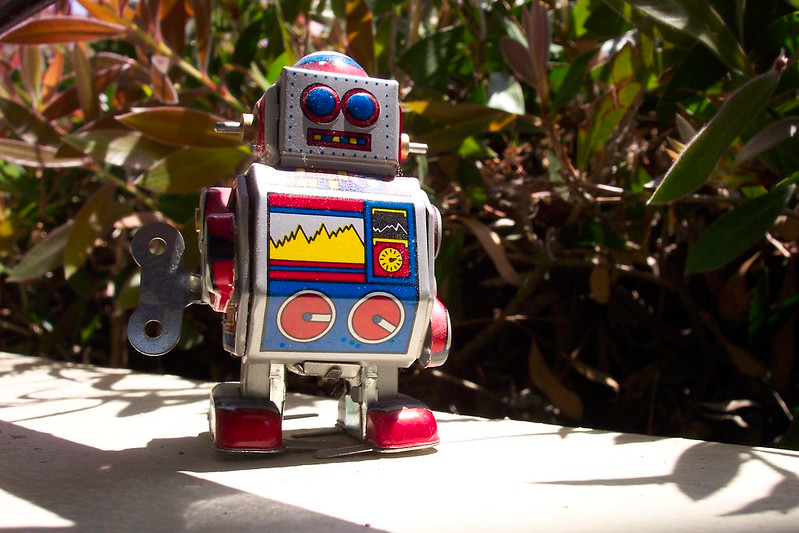
Given that the subject matter of my assignments to date have been robots, I decided to create a “Robot Source Material” gallery, sourced from Openverse. Enjoy!
Robot Source Material
This collection is licensed under a Creative Commons Attribution-ShareAlike 4.0 International License
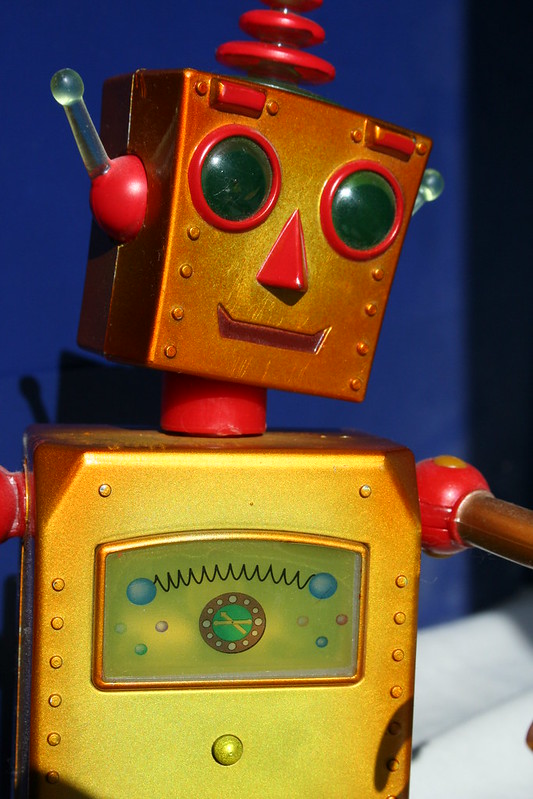
CC BY 2.0


When looking to include works in the collection, I came across some sources, like this book cover, where I wasn’t sure of the copyright status so I didn’t include them (given that the image appears to be an exact copy of the book cover, is the person posting it actually the copyright holder, and do they have the right to share under a CC license?). I also encountered some sound resources that were available under a CC license or public domain tool (ex. Toy Robot Blorping, Wake Up the Robot), but required me to log in to download, which wasn’t as open as I would have liked.
Anyway, that’s it for me this week, stayed tuned for the last in-course assignment (about Open Access and Open Educational Resources), and then the final, self-directed project!
The work on this page is licensed under a Creative Commons Attribution-ShareAlike 4.0 International License unless otherwise noted.
 Jordan Pedersen
Leave a comment